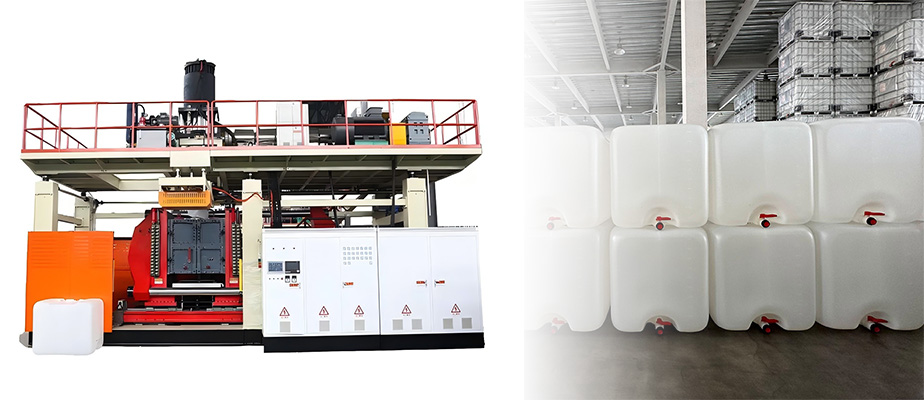
When sourcing an IBC blow molding machine for your production line, reviewing its technical parameters is the most important step before purchase. All core performance such as running stability, finished IBC tank quality, hourly output and long-term operating costs are governed by professional technical specifications.
This in-depth guide walks you through all vital technical parameters of IBC blow molding machines. We cover clamping performance, extrusion capacity, mold design standards, cooling cycle performance, intelligent automation configuration and energy-saving design, helping factory buyers and investors compare models easily and make a reliable purchasing decision.
1. Clamping Force: Foundation of Stable Molding Performance
Clamping force refers to the mold locking power that keeps the mold fully closed throughout the blow molding cycle. Sufficient clamping force avoids mold parting, plastic overflow, flash generation and uneven wall thickness of 1000L IBC tanks.
Common standard clamping force range: Single-station IBC blow molding machines usually feature 300 kN to 600 kN clamping force. For high-volume continuous production, higher clamping rigidity delivers better molding accuracy and longer equipment service life.
Pro advice: Select models equipped with servo-type clamping drive. It maintains stable mold locking precision and effectively cuts idle power consumption, ideal for long-time non-stop factory operation.
2. Extrusion System and Production Output Specification
The extrusion unit is the core component of an IBC blow molding machine, dominating plastic melting quality, plasticizing effect and material supply efficiency.
Major extrusion technical parameters:
Screw diameter: 90 mm to 120 mm, directly deciding plasticizing volume and melting speed
Extrusion capacity: 250 kg/h to 450 kg/h, adjustable according to screw structure and rotating speed
Multi-layer extrusion capability: supports 2 to 6 layers, greatly enhancing chemical barrier, anti-static and UV-proof performance for chemical-grade IBC tanks
Pro tip: If you focus on mass production or need chemical-resistant multi-layer IBC containers, prioritize machines with high-efficiency heavy-duty extrusion systems.
3. Mold Configuration and Versatile Compatibility
Mold structure and material quality directly determine the dimensional accuracy, surface finish and service life of finished IBC tanks.
Key technical features of standard IBC molds:
Mold material: high-grade aluminum alloy or premium carbon steel for wear resistance and long service life
Quick mold change structure: minimize production downtime when switching different tank specifications
Buyer suggestion: Modular mold systems are highly recommended, allowing fast replacement to produce various IBC tank styles without major equipment modification.
4. Cooling System and Molding Cycle Time
Cooling efficiency is a decisive factor affecting production speed, defect rate and overall energy consumption.
Core cooling related parameters:
Cooling type: water-cooled molds far outperform air-cooled types with faster heat dissipation and higher hourly output
Standard cycle time: 100 to 150 seconds per IBC tank, varying by cooling system design
Chiller configuration: large-scale production lines require 30 kW to 50 kW cooling capacity chillers
Practical tip: Optimized cooling design effectively reduces product deformation, avoids surface defects, shortens cycle time and greatly improves overall production capacity.
5. Automation Configuration and Intelligent Functional Design
Modern IBC blow molding machines are upgraded with Industry 4.0 intelligent technologies to boost automation, stability and easy management.
Main intelligent and automated functions:
PLC and HMI interactive control for real-time parameter monitoring and one-click operation
IoT remote connection supporting equipment status tracking and predictive maintenance
Robotic handling systems for automatic tank demolding, conveying and stacking
6. Energy Consumption and Energy-Saving Technical Design
Energy saving has become a core evaluation index to control long-term factory operating costs.
Classic energy-saving configurations:
Servo hydraulic drive system: reduce comprehensive power consumption by 20% to 30%
High-efficiency heating components: minimize heat loss and improve plastic melting efficiency
Regenerative braking design: recycle redundant mechanical energy into reusable electric power
Selection tip: Give priority to machines with professional energy-saving certifications, which help factories lower electricity costs and meet green production standards.
Final Conclusion
Learning and comparing the full technical parameters of IBC blow molding machines allows manufacturers to match equipment exactly to their production scale and product positioning. Always evaluate clamping force, extrusion performance, mold compatibility, cooling cycle efficiency, automation level and energy-saving performance to complete a cost-effective and future-oriented equipment investment.
In our next article, we will introduce the complete IBC tank manufacturing workflow, from raw material feeding and plastic melting to molding, trimming and final pressure & leak testing.
Hwashi also excels in overseas after-sales service, with its equipment exported to more than 90 countries and regions including North America, Europe, the Middle East and Southeast Asia.